

Are you looking for a reliable engine block casting manufacturer for automotive production? Do you need aluminum or cast iron engine blocks with consistent casting quality, dimensional accuracy, and machining compatibility? Or are you comparing manufacturers that can support prototype development, customized casting, and high-volume production?
If the answer is yes, choosing the right supplier requires more than simply comparing company size. Casting process, material capability, production experience, machining capacity, quality control, and experience with automotive applications can all affect the final result. To help buyers compare potential suppliers, this article introduces ten established companies involved in engine block casting and related automotive casting production around the world.
Top Ten Own Brand Engine Block Casting Manufacturers:
1. BESSER
Established time: Manufacturing history since 2002; Besser Casting Co., Ltd. established in 2015
Headquarters: Cixi, Ningbo, China
Main products: stainless steel engine block-related castings, carbon steel engine block-related castings, alloy steel automotive castings, tool steel precision castings
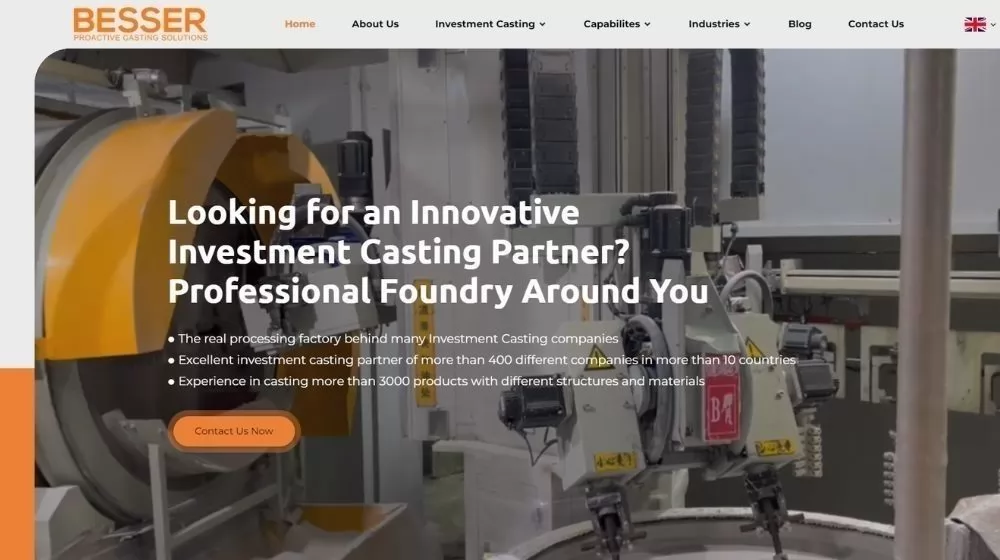
Company profile: BESSER is a Chinese investment casting manufacturer with manufacturing roots dating back to 2002 and Besser Casting Co., Ltd. established in 2015. Its business covers precision metal casting for automotive and other industrial applications, with capabilities covering stainless steel, carbon steel, alloy steel, nickel-based and other engineering alloys. For automotive projects, BESSER's official product information includes engine mounts and blocks among its automotive casting applications. The company combines casting, tooling, heat treatment, machining, and surface-treatment capabilities to support customized components from prototype development through batch production. Its investment casting process is suitable for complex geometries where dimensional control and detailed features are important, making the company relevant to buyers seeking customized engine-block-related castings and other precision automotive components.
2. Nemak
Established: 1979
Headquarters: Monterrey, Nuevo León, Mexico
Main products: aluminum engine blocks, cylinder heads, transmission cases, differential housings
Company profile: Nemak is a global automotive component manufacturer with a long history in lightweight aluminum casting. The company was founded in 1979 in Monterrey and developed its engine-block expertise through the production of complex aluminum powertrain components. Nemak's current product portfolio includes engine blocks, cylinder heads, transmission cases, differential housings, and other structural castings. Its manufacturing technologies include high-pressure die casting, low-pressure die casting, gravity casting, rotating casting, and other specialized processes. With production and development operations across multiple countries, Nemak serves global automotive manufacturers that require lightweight powertrain components, high-volume production, and engineering support for customized applications.
3. Linamar Corporation
Established: 1966
Headquarters: Guelph, Ontario, Canada
Main products: aluminum engine blocks, cast iron engine blocks, cylinder heads, machined engine components
Company profile: Founded in 1966 in Guelph, Ontario, Linamar has developed into a diversified manufacturer serving the mobility and industrial markets. Its Mobility business includes casting and precision machining capabilities for engine components, with both aluminum and ductile iron casting processes. The company specifically lists cylinder heads and blocks as part of its mobility product portfolio and combines casting with machining, assembly, testing, engineering, and process development. Its manufacturing approach is suitable for automotive programs requiring complex thin-wall structures, controlled material properties, precision machining, and repeatable production at scale.
4. Grede Holdings LLC
Established: 1920
Headquarters: Southfield, Michigan, USA
Main products: heavy-duty engine castings, powertrain castings, chassis castings, safety-critical iron components
Company profile: Grede traces its foundry history to 1920, when its original foundry operation was established in Wauwatosa, Wisconsin. Today, the company focuses on highly engineered iron castings for automotive, commercial vehicle, and industrial applications. Its product portfolio includes powertrain and chassis components, with particular experience in heavy-duty vehicle applications where strength, stiffness, weight, durability, and dimensional consistency are important. Grede combines foundry engineering, molding, melting, casting, finishing, and machining capabilities to produce complex iron components for demanding vehicle programs. Buyers requiring heavy-duty powertrain castings can use its engineering and production capabilities for customized component development and series manufacturing.
5. RYOBI LIMITED
Established: December 16, 1943
Headquarters: Fuchu, Hiroshima, Japan
Main products: aluminum die-cast cylinder blocks, transmission cases, automotive chassis castings, precision die-cast components
Company profile: RYOBI LIMITED was established in 1943 and began die-casting production in 1944. The company has built its automotive business around aluminum die casting and supplies components such as cylinder blocks, transmission cases, and chassis parts. Its manufacturing network includes production operations in Japan as well as overseas locations, supporting automotive customers that require lightweight aluminum castings and high-volume die-casting production. RYOBI's experience with large die-casting equipment and automated production cells makes it relevant to engine-block programs where repeatability, productivity, dimensional control, and lightweight construction are key requirements.
6. Toyota Industries Corporation
Established: November 18, 1926
Headquarters: Kariya, Aichi, Japan
Main products: cast iron cylinder blocks, aluminum cylinder blocks, cylinder heads, crankshafts
Company profile: Toyota Industries Corporation was established in 1926 and has developed manufacturing businesses covering automobiles, engines, and automotive components. Its engine-related manufacturing includes cast iron and aluminum engine components, including cylinder blocks, cylinder heads, camshafts, and crankshafts. The company's foundry technologies cover applications for both gasoline and diesel engines, including high-output engine components that require controlled material properties and structural strength. Its combination of engine development, casting, machining, and production engineering provides an integrated manufacturing environment for automotive powertrain components.
7. Teksid S.p.A.

Established: 1978 as the Teksid brand
Headquarters: Carmagnola, Turin, Italy
Main products: aluminum engine blocks, iron engine blocks, cylinder heads, automotive cast components
Company profile: Teksid has a long history in automotive foundry production, with the Teksid brand established in 1978 and earlier industrial activities preceding the brand. Its aluminum operations include the Carmagnola plant in Italy, which develops, industrializes, and produces cylinder heads and engine blocks using gravity casting. The plant also carries out tooling, heat treatment, and pre-machining activities and has reported annual production capacity of approximately 36,000 tonnes. Across its automotive foundry activities, Teksid has experience with both aluminum and iron powertrain components, supporting vehicle manufacturers that require engineered casting solutions, process development, and production-quality automotive components.
8. Ashok Leyland Limited
Established: 1948
Headquarters: Chennai, Tamil Nadu, India
Main products: engine blocks, cylinder heads, automotive castings, industrial engine castings
Company profile: Ashok Leyland was incorporated in 1948 and has developed extensive manufacturing capabilities for commercial vehicles and engines. Its foundry business was established in 1961 and is described by the company as one of the large engine-block and cylinder-head manufacturing operations in India. The foundry includes molding, core making, fettling, product development, pattern manufacturing, and machining capabilities. Its castings serve automotive, tractor, industrial engine, construction equipment, and power-generation applications, allowing the company to handle engine components where material performance, dimensional accuracy, and production consistency are important.
9. Nelcast Limited
Established: 1982
Headquarters: Chennai, Tamil Nadu, India
Main products: grey iron engine blocks, ductile iron engine blocks, cylinder heads, exhaust manifolds
Company profile: Nelcast Limited was founded in 1982 by P. Radhakrishna Reddy and began commercial production in 1985 at Gudur. The company specializes in grey iron, ductile iron, ADI, and other specialty iron castings and serves automotive, tractor, construction, and railway customers. Its product portfolio includes engine blocks, cylinder heads, and exhaust manifolds, while its manufacturing capabilities extend from rough castings to fully machined subassemblies. Nelcast's experience with automated molding and engineered iron grades makes it suitable for buyers looking for cast iron powertrain components with subsequent machining and production support.
10. Fritz Winter Eisengießerei GmbH & Co. KG
Established: 1951
Headquarters: Stadtallendorf, Hesse, Germany
Main products: lightweight steel engine blocks, passenger-car cylinder blocks, commercial-vehicle cylinder blocks, automotive iron castings
Company profile: Fritz Winter Eisengießerei was established in 1951 and has developed extensive expertise in iron and steel foundry technology. The company is particularly known for its ecoCasting process for lightweight engine blocks, which uses recycled steel scrap and is designed to produce thin-wall cast steel components. Its ecoCasting technology has been applied to passenger-car and commercial-vehicle cylinder blocks, with documented wall-thickness specifications for different applications. The company operates production and development locations in Germany and other markets and combines foundry engineering with process development for automotive components. This makes Fritz Winter relevant to buyers investigating lightweight cast steel engine blocks and alternative materials for powertrain applications.
Frequently Asked Questions
1. How can I tell whether a mark on an engine block is a casting defect or a crack?
A surface line is not automatically a crack. Casting marks, machining marks, shrinkage-related features, and actual cracks can look similar after production. The practical approach is to clean the area first and then use an appropriate inspection method, such as dye penetrant testing for suitable materials or other non-destructive inspection methods specified by the manufacturer. For critical engine components, visual inspection alone should not be treated as sufficient evidence.
2. Is porosity in an engine block a serious problem?
It depends on the location, size, distribution, and application. Porosity in a non-critical area may have a different effect from interconnected porosity near an oil passage, coolant passage, sealing surface, or highly loaded structural area. Buyers should therefore specify acceptable porosity criteria during the quotation and approval stage rather than judging the casting only by its external appearance.
3. Should I choose an aluminum or cast iron engine block?
The choice depends on the engine design, required weight, thermal behavior, strength requirements, production volume, and total manufacturing cost. Aluminum is commonly considered when weight reduction is important, while cast iron remains relevant for applications requiring high stiffness, durability, and established heavy-duty performance. The material should be selected together with the casting process and final machining requirements.
4. Why can an engine block leak after machining even when the casting looked acceptable?
Machining can remove a surface layer and expose internal porosity or other discontinuities that were not visible on the original casting surface. This is why pressure testing, leak testing, or other inspection methods may be required after the relevant machining operations. The inspection stage should be agreed with the customer before mass production rather than added only after leakage problems appear.
5. How much machining allowance should be left on an engine block casting?
There is no single allowance that works for every engine block. It depends on the casting process, material, casting size, dimensional variation, deformation risk, and the final machining process. A foundry normally determines the allowance from the finished-part drawing and process capability. Excessive allowance increases machining time and material removal, while insufficient allowance can create problems when the casting varies from the nominal geometry.
Conclusion
Engine block casting requires a combination of suitable materials, controlled casting processes, accurate tooling, machining capability, and consistent quality inspection. The manufacturers listed above represent different approaches, including aluminum die casting, iron casting, investment casting, and lightweight cast-steel technology. When selecting a supplier, buyers should match the manufacturer's process and material capabilities with the engine design, production volume, dimensional requirements, and final application.
For buyers looking for customized automotive casting solutions, Besser can provide investment casting and related precision metal casting services for customized components. Its capabilities cover multiple engineering alloys and support tooling, casting, machining, and finishing requirements. If you are developing a new engine-block-related casting or need a customized automotive casting solution, you can contact Besser with your drawings, material requirements, quantities, and technical specifications for further discussion.